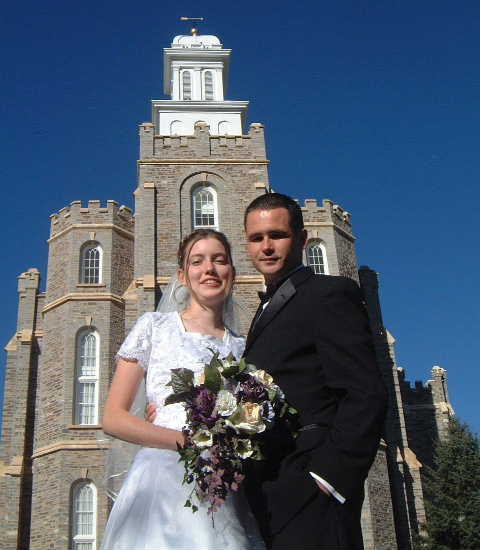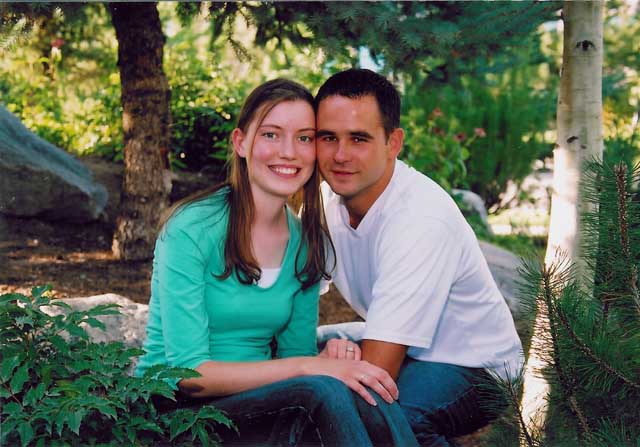
Reed and Jennifer married on October 5, 2001 in the Logan Temple.
Reed and Jennifer
Allen
Reed
and Jennifer married on October 5, 2001 in the
Logan Temple.
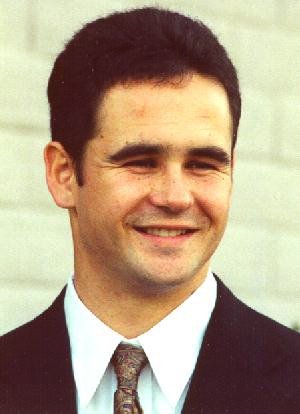
Reed is an immigration attorney based in Las Vegas, Nevada. An avid soccer player and coach, he has coached his second daughter's youth soccer team to a regional championship. In February 2010 he joined the Phoenix office of ICE after more than two years representing immigrants with The Joseph Law Firm of Aurora, Colorado. He is a June 2007 graduate Ave Maria School of Law formerly in Ann Arbor, Michigan, and an August 2003 graduate of Brigham Young University, majoring in International Relations and Spanish. He served as a missionary for The Church of Jesus Christ of Latter-day Saints in Uruguay from January 1999 to December 2000. At BYU he renewed his acquaintance with Jennifer Elaine Wayment of Burley, Idaho. They first met on a family tour of Israel in 1997-98.
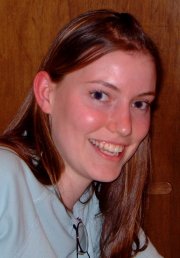
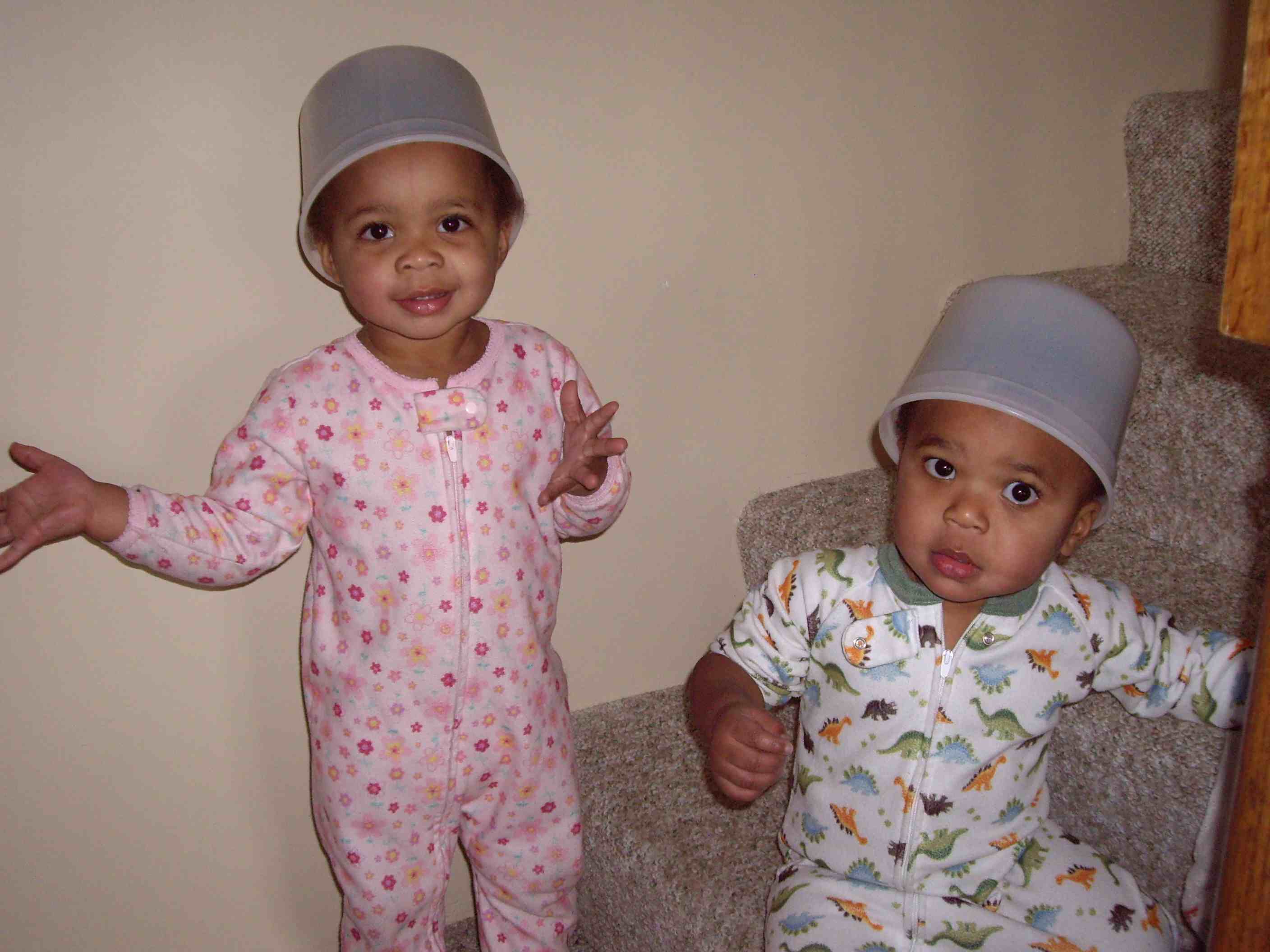
Jennifer is a 2006 Nurse Practitioner graduate of the University of Michigan School of Nursing in Ann Arbor, where she served as a teaching assistant and graduated at the top of her class. Jen graduated from Burley, Idaho, High School in 1998 as valedictorian and graduated as the valedictorian of the BYU College of Nursing, Class of 2002. Jen is a pianist and a doting mother of four. Reed and Jen adopted infant twins Lucas and Lilliana born 2006 and two have younger daughters Myra (2013) and Callie (2020).
Reed's History
Reed
is a 1997 graduate of Midland
School near Los Olivos, California, a rustic private college prep
boarding school on a ranch in the Los Padres National Forest.
Although his early attraction to the school was his interest in
horses, he captained the soccer team and led the lacrosse team, broke
his wrist playing baseball, played briefly in the Santa Barbara Youth
Symphony and won the annual Santa Inez Valley Applause music
competition. Over his years at Midland he was recognized as both the
school's outstanding musician and outstanding athlete and he was
chosen to be both the School Prefect and Prefect over several
classes, receiving the school's outstanding leadership award at
graduation. In his spare time he earned the rank of Eagle Scout.
After high school graduation, he attended UC Santa Cruz for four quarters, where he majored in South American Studies. He also studied one quarter in Morelia, Mexico and spent a summer in San Lucas Tolemon in Guatemala and joined in an earthquake relief work project in Nicaragua.
Reed is a gifted musician. He plays violin, guitar, keyboard, and he sings and composes music. Here is "Soledad," a song he composed for Jen. He is playing the guitar, accompanied by his foster brother Tim Schmalbeck. He is also a serious soccer player, leading both his law school and city league teams to successful seasons. A version of this was sung at his wedding, as seen on YouTube.
Reed's LDS Mission
Reed
served from January 1999 to December 2000 in voluntary service as a
missionary for the LDS Church in
The Uruguay
Montevideo Mission, a mostly rural South American country.
Here is a detailed map of Uruguay.
As activities, he taught the Gospel in Spanish, sang with his
companion as they strolled, taught soccer (futbol) to the local
children, visited church members, and attended lots of meetings.
He walked everywhere. On "P-Day" (preparation day)
once a week, he played futbol, practiced his violin, toured within
his small area and helped people in need. For example, as
District Leader in Santa Lucia, he helped paint a preschool.
Reed's first mission president was President Timothy Olson. Reed first served in Maldonado near the beach resort of Punta del Este with Elder Boyack (February to May 1999); then with Elder Williams in Belloni, a barrio in the Maroñas District of northern Montevideo near Piedras Blancas (May to August 1999); and then in August and September 1999 with Elder Haymore in Santa Lucia, about 50 km north of Montevideo. On September 8, 1999 Elder Haymore went home, and Reed, after only 6-1/2 months of service, was assigned to be a senior companion for the first time and to lead the other missionaries in the area as District Leader. He lived in Pueblo Nuevo and served as District Leader of the Santa Lucia District, enjoying great success in this small city of 17,000. On October 6, 1999, he was transferred to the city of Durazno in central Uruguay and was called to be the traveling Zone Leader with Elder Barney from Gilbert, Arizona. Together they supervised all the missionaries in the Este (East) Zone.
Early in November, 1999, Elder Barney returned to the U.S. and to Reed's surprise Elder Whittaker of Richfield, Utah, was assigned to be his companion as Zone Leader. In the summer of 1998, Reed had painted Elder Whittaker's home in Richfield, Utah, while working with his brother-in-law Brandon Mills, who is from nearby Kingston in Piute County. As Zone Leaders of Zona Este, they supervised missionaries in Durazno, Sararndi del Yi, Florida, Paso de los Torros and Trinidad. They traveled as much as 1.5 hours by bus each way to visit the districts.
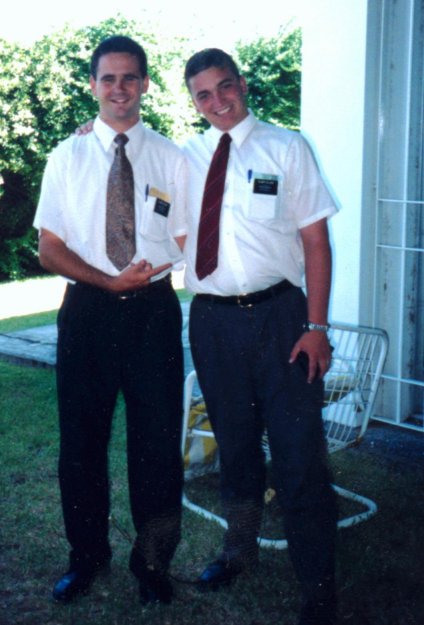
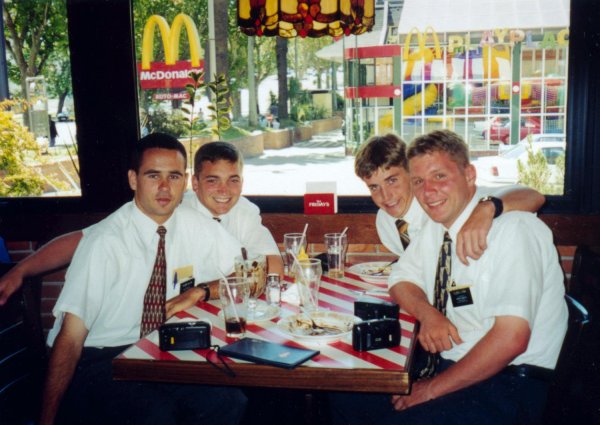
On December 1, 1999, Reed was transferred to Paso Carrasco at the southeastern edge of Montevideo, near the seacoast, in the Departmento Cannelones, where he continued as a Zone Leader. His companion was Elder Stocks of Orem, Utah. He completed his mission and went home about February 1, 2000. His next companion was Elder Polo from Peru. A good buddy in his district was Elder Wilcock (pictured here with Reed) . Montevideo is large and modern. Here is Reed with three other missionaries at TGIFridays in front of McDonald's!
At Christmas in 1999, Sister Olson played piano with Reed as he played his violin for a general Mission Conference attended by many members and by Elder Halliday, a Church General Authority. Sister Halliday wrote a very nice thank-you note to his family about his performance of Massinet's "Mediation."
Reed reported that the dogs can be very difficult to deal with. He and Elder Polo encountered a couple of large menacing dogs as they were visiting a neighborhood near their apartment. Thinking quickly, he dropped his backpack and started hopping around and yacking like an crazy monkey. The dogs were so confused and perplexed that they whimpered off to their doghouse. Reed and Elder Polo were laughing so hard they had to lean against a tree to keep from falling over.
On April 1, 2000, Reed completed six months as Zone Leader and was transferred to the "new town" barrio of Los Ceibos on the outskirts of the city of Pando, about 20 km northeast of Montevideo. He became a trainer, responsible for shepherding "Oros" or "greenies" through the rigors of the first months of a mission. His first new companion was Elder White, fresh from Orem, Utah. Reed enjoyed working with the small struggling congregation (ward) and sharing the excitement of the Uruguayans as they rooted for the national team in the World Cup Qualifying Rounds. It was a windy, wet and cold season.
In June 2000, President Olson was released to return home to Texas, and the mission welcomed President R. Quinn Gardner, who had previously served as president of a mission in Chile. On July 27, Reed was transferred to Barrio Peñarol in northwestern Montevideo to join a new companion Elder Rojas from Argentina, and he was again assigned to be District Leader. Elder Rojas, short and pudgy, is of Filipino heritage, and they both got along very well. The Church membership in the community is large and relatively strong, and the eight missionaries in this district are from Argentina, Chile, Peru, Bolivia and Paraguay. Reed was their trainer and leader. On August 23, Elder Rojas was transferred, and Reed was assigned Brother Rodrigo Martinez, a young Uruguayan from the city of Treinta Y Tres who was serving a five-week "mini-mission."
On Sunday August 20, as Reed and his companion Elder Rojas passed a house occupied by a group of known 16-year old boys who liked to attack the missionaries, a huge rock came flying past them, barely missing them. The rock had come from the back of the house, so the two Elders went back to talk to the boys. When they knocked on the door, they immediately realized it was the wrong house as a tall thirty-ish man answered the door. They took advantage of the encounter. They had no more introduced themselves as missionaries when he said, "Come in, let's talk." They joined Fabion in his humble home and began to teach him their message of the Restoration of the Gospel of Jesus Christ, brought by living prophets and new scripture. The "Spirit" knocked him flat! He then told them the following story. No more than thirty minutes before he had been reading the Bible and watching a contradictory documentary on television, feeling great confusion about the different doctrines. He then prayed fervently that the Lord would help him understand. Then twenty minutes later, he heard a knock, and there stood messengers from Jesus Christ Himself: Elder Allen and Elder Rojas. Reed, too, was overcome. He was grateful that he had developed enough love for his enemies to overcome the negative feelings against an attacker, and he learned that sometimes the Lord has to allow stones to be thrown to get Reed's attention! During the next several weeks, Fabion studied faithfully, came to church where he found friends he knew already, and he accepted the challenges. At the end of one discussion, he said, "I asked God to open my eyes to the Truth, and every time I talk to you, He does so more and more." He read voraciously, studied, and prayed, and he shared what he learned with his many friends and family. His wife and son live in the country while he seeks work, so he had a lot of time to study, and he used every opportunity to tell anyone he knew about the message of the Restored Gospel. After three weeks, he moved to Las Piedras to live with his mother, where he was to be baptized. Reed reported that Fabion has a deep understanding and that he has a favorite law of God. Reed said he never thought of having a favorite law or commandment. For Fabio, it is the Law of Tithing.
On September 24, 2000, Reed's young companion Brother Rodrigo Martinez was transferred to Aeropargue, and Reed welcomed a new companion, Elder Fusano of Cali (Colombia), who had been serving 17 months. Elder Fusano took over from Reed as District Leader in Peñarol after a week of orientation.
On October 4, Reed was transferred to Treinte y Tres ("33")
in the interior of Uruguay to open a new area, called Plaza, with a
new young missionary companion, Elder Bauman from Sandy, Utah. All of
the other seven missionaries in the region are from Utah, Reed being
the only one from California. His "mini mission" companion
Rodrigo is from this city, and Reed met his mother. He found the
people in 33 to be very nice, with strangers even giving them cookies
and cars stopping for them to cross the road. He opened and
completely furnished a new apartment, meanwhile walking everywhere
and playing futbol very early in the morning before study time to get
back into shape. The weather and food poisoning was a challenge. To
his surprise he and his companion met an American girl in the
neighborhood. She was from Santa Cruz, California, where Reed had
gone to college. It prompted him to reflect on how foreign and
strange the missionary way of life is to the rest of the world.
__________
Reed was excited by his many opportunities to serve. He acted as interpreter to the members for the talks of visiting authorities, performed the inspiring "The Spirit of God Like a Fire is Burning" in a trio with Elders Booth and Garcia, and he worked closely with President Gardner and the other District Leaders such as Elders Lee and Vasalt and the Zone Leaders to build the community spiritually. He looked forward to the dedication of the Montevideo Temple, but was unable to witness it prior to his departure for home on December 19, 2000. However, he received a personal guided tour of the construction site prior to returning home.
Reed learned many things on his mission:
The importance of
standing up for something.
The importance of keeping the little
rules.
The importance of reading the scriptures every day and the
strength gained from them.
The importance of member support in
the wards and branches of the Church.
The importance of
forgiveness and obedience to the promptings of the Spirit.
He
also learned that he loves little children a lot.
Reed saw many people join the Church and was responsible for helping them through all aspects of preparation for baptism. He said that baptisms give a kind of "final exam stress" to a missionary: "Is there water, gas, clean font/capilla, clothes for the convert, assignments for meeting, Plan B's for when people don't show up, baptismal interviews, etc. ... It's great having them but there's also a huge stress taken off when it's over."
Reed watched many people come close to the Spirit and then back away when they realized with the "Change the Gospel Brings" comes challenges, and he witnessed the Power of One to Effect great changes, often long in the future, such as happened to the Prophet Abinadi and the Prophet Alma. Reed survived food poisoning, storms, stones, sliced fingers from broken dishes, dark spirits, the illnesses of his companions and brutal games of futbol. His idea of an awesome P-Day was seven hours of non-stop soccer where he had to stop after every shot to stretch the muscle spasms out of his calves and stuff his toes back into shoes that have bottoms worn through.
Reed learned from his colleagues how to relax so he could continue to work hard. Reed is a horse lover. So whenever he saw a horse in the street, he gave it a hug and savored its smell, the smell of a horse being the only thing that was the same as at home.
Reed returned home to California on December 20, 2000, just in time to celebrate Christmas with the family. He entered BYU and lived with his foster brother Tim Schmalbeck. It was quite a reunion after four years of separation.
Writings
Reed, a thoughtful thinker, has commented about world affairs and the complications of war.
As he approached the end of his mission, Reed reflected on the time he served and wondered how to assess what he achieved. "It is not so easy, as it is for an architect or farmer, who at the end have in their hands, or before their eyes their fruits. The most important thing is whether or not in the eyes of the Lord the offering is acceptable." Reed wrote the following "Epistles" (1 Reed, 2 Reed) to the family:
1
Reed
First Epistle of Reed
On
the Purpose of Life
A
letter from Los Ceibos, near Pando, Uruguay, to his family in Palo
Alto, California, 7 June 2000
Dear Family:
1.
What we often teach, or testify about, in heart discussions is the
purpose of life. I've found that subject to give me great
strength and comfort.
2. We begin by explaining our origin as spiritual
intelligences, literal offspring of God with the desire of God (and
ours) to become as He is. (Abraham 3:22-25).
3. The two aspects in which we differed from God were a
physical body which gave us power to act, and spiritual progression.
4. As Alma (the
ancient American prophet) states so effectively, this life is a state
of probation. (It is interesting that probar means
to test in Spanish.) Alma 12:24.
5. Our purpose is to dominate our bodies in order to be fit for
God's presence.
6.
With this test comes tribulation which is necessary for progression.
(2 Nephi 2:13-16 and 2 Nephi 2:2).
7. So the purpose of life is thus, progression and preparation,
but what is the ultimate goal? Return to God's presence for
what?
8. Lehi
continues to explain this to his son Jacob when he taught, 2 Nephi
2:25 -- "Adam fell that men might be and men are that they might
have joy." So simple it all is. Happiness.
9. How is happiness obtained? One way: As when a
man falls he feels physical pain, so there are natural consequences
in the spiritual realm (yes, thus destroying relativism).
10. When I do good I feel good. When I do bad I feel bad.
11. Okay, so the
world is not relative, but what is "good" and what is
"bad?" Why should your good be mine?
12. Well, first there must be an agreement before this
conversation starts that the most important thing is finding the
truth of good and bad, not whose it is.
13. For all beliefs we have come from an outside source.
From our parents (in favor or opposition), friends, etc...
14. Many times we unconsciously adopt a belief or behavior
because of outside influences.
15. Okay, so everything we believe in comes from somewhere.
The important thing is to somehow analyze and test the validity of
our set "truths."
16. In the Christian world the Ten Commandments and others
given through prophets are what define our good and bad, but how can
we come to be able to believe in these truths?
17. What's the purpose of life? Learning through
experience.
18.
Jesus taught this same concept when he perceived doubt in the hearts
of his listeners. (John 7:17).
19. We must act to experience the natural results of our
actions.
20. I
will never know what lies over the next hill until I climb it.
21. So does that
mean I spend my whole life aimlessly trying and failing? No.
God is a loving father, or thus is it taught in the Christian realm,
and if so he would not leave us alone.
22. Jesus taught of a Comforter that would be sent with the
assignment of teaching and guiding mankind, an open line of
communication between God and man. (John 14:26). That Comforter
is by name the Holy Ghost.
23. Well, if the Holy Ghost is going to teach me I must be
conscious of his influence, or familiar with his form of
communication.
24.
In Galatians 5:22-23, Paul speaks of the way in which the Holy Ghost
communicates on a spiritual level.
25. How does one feel when they have a child? (I really
don't know, though I have nieces.) Those feelings come from the
Holy Ghost that teach the importance and joy of family.
26. So, basically it is thus: God speaks to His children in a
language that has no nationality nor native region. Something
that every human being can understand, emotions.
27. A little wishy washy? Perhaps at first. Think
of Ghandi, Rosa Parks, Joan of Arc, Paul, or any other figure known
for good. Why did they do it? Conviction.
28. Where does such conviction come from? Inside,
feelings. These things are true. I am convinced.
Why? Because I felt something and decided to investigate and it
has filled my soul.
29. Life contains truth and as Jesus taught: Know the
truth and the truth shall set you free. (John 8:32).
30. I join with Paul's testimony when he said: Romans
1:16. These things are true and will change the life of anyone
who honestly seeks the truth. This is my testimony of this
life. And I leave it with you in the name of our Lord and
Savior Jesus Christ, Amen.
Elder Allen
2
Reed
Second Epistle of Reed
A
Poem on the Experience of a Mission
A
letter from Los Ceibos near Pando, Uruguay, to his family in Palo
Alto, California, 17 July 2000
Dear Family:
1. My head is spinning, but I need to write, for tomorrow we
send letters. What has happened: I've
2. played with a huge bull, wrestled a sheep,
3. fallen in the mud (in my suit) a few times, watched my comp
fall in a creek with our lunch,
4. wandered through the countryside in the middle of the night
in a huge rainstorm and 90 km/h winds,
5. been heckled by kids, heckled them back,
6. walked 150 km (the last three weeks),
7. learned how to bee keep,
8. been bit by dogs, bit them back,
9. almost blown out the church's electrical system,
10. ran away from girls (literally),
11. cleaned the apartment, messed it up again,
12. showered, shaved, cut my own hair (gotten pretty good),
13. laughed,
yelled, whispered, sung, taught, listened, hurt, enjoyed, stressed,
relaxed, worked, slept,
14. thrown my comp in the mud when he laughed at me for
falling,
15.
improved, retrogressed,
16. written an essay, crumpled up an essay,
17. complained about the cold, thanked God it's not summer,
18. complained
about the people, thanked God for their beauty,
19. watched a sun set, watched the sun rise,
20. walked by the moon's light, stumbled by its absence,
21. cursed the
cold wind, been lulled to sleep by its rushing through the trees,
22. wanted to be
home, feared the mission's end;
23. lived.
Love
Elder Allen
An Experience that
Built Character
An
essay about an incident in Guatemala (written July 2000 in Pando,
Uruguay)
The hollow tension
of night's arrival was accompanied only by a single rooster's call in
the vacant cobblestone streets of San Lucas Tolimân. This tension
had fifty years of residence in Guatemala's violent revolutionary
history.
Three and one-half weeks in Guatemala
working as a volunteer in the small indigenous village had me
accustomed to such an ambiance. The jolly shouts of my high school
comrades accompanied "El Gallo" in his late dusk song as we
headed for home after the day's activities.
We
continued past the town bar crowded with silent dark sagged
faces--sagged by experience, not years--greeting our neighbor Lucas
as he headed for the bar. The joviality of the group now excluded Ben
and myself, fatigued by the repetitive conversation of 16-year-olds.
A block from the bar three explosions cracked the night air behind
us. As firecrackers were common, the most part of the group took no
notice. Ben and I, however, turned to witness the last two slugs
enter Lucas's chest. We returned to help but his last breath had been
taken, his still lit cigarette made mock of the frailty of life. I
stared as a woman searched him for money, not life, and couldn't turn
away.
They called it a "Political
Assassination." The murderers were found but the life was never
recovered, and mine, as all others present, was forever changed.
Experiencing death's reality brought to me an appreciation for life's
joys and pains. It was an experience that taught me soberness and
truth and the results our decisions can have if we do not properly
order our priorities.
Updated 12 May 2023